
How is chocolate made? In this article, we’ll discuss the steps involved in the different processes that most manufacturers use. It’ll help you understand the basic method of making chocolate, from harvesting to tempering and packing.
Step-By-Step Process of Making Chocolate
Chocolate is a popular treat in the United States and many other countries around the world. Not only does it taste good, but it also offers many health benefits. So, it should come as no surprise that global chocolate consumption in 2022 was around 7.5 million tons.
Chocolate manufacturers buy cocoa beans from farmers and process them into chocolate using a variety of techniques. The chocolate production process can vary depending on the type of chocolate being made and the specific methods used by the manufacturer.
If you’ve ever wondered how chocolate is made, here’s a step-by-step process that manufacturers use to make chocolate.
Step 1: Harvesting the Cacao Beans
The first step in the chocolate-making process is harvesting the cacao beans. These beans grow inside cacao pods on the Theobroma cacao tree, which is native to Central America and South America.
We have been fortunate to visit cacao farms in Honduras and St Lucia where they focus on sustainable production. Cocoa fruit are also grown in West Africa. Cocoa farmers harvest cacao pods (also called cocoa pods) by hand using a machete or other sharp tool.
Cacao pods are usually harvested twice a year, and they are ripe and ready for harvest about 5 to 6 months after the flowers on cocoa trees bloom.

Step 2: Fermentation of Bean
After harvesting the cacao pods, the next step is to remove the beans from the pods. This is done by cutting open the pods and scooping out the beans. The beans are then placed in piles or bins to undergo the fermentation process, which helps develop their flavor.
During fermentation, banana leaves are used to cover the beans, which protects them from environmental elements. The fermentation process lasts for several days (a week or so), during which the beans are turned regularly to ensure that they ferment evenly.
In this process, the beans release heat and moisture, which helps break down their flesh. It also activates the enzymes that contribute to the development of their flavor.

Step 3: Drying the Fermented Beans
Once the fermentation process is complete, the cacao beans are dried in the sun or through specialized drying machines. The drying process helps reduce the moisture content of the beans, which helps preserve them and make them easier to store.
The beans are typically dried to a moisture content of around 7%, and after that, they’re shipped to chocolate makers worldwide.

Step 4: Roasting Cacao Beans
The next step in the chocolate-making process is roasting cacao beans. This step helps to further develop the chocolate flavor of the beans and makes them easier to hull (the removal of the outer shell).
Roasting also helps kill any bacteria or other contaminants that may be present in the beans. They are roasted in a large industrial oven at a temperature of around 250 to 275 degrees Fahrenheit for about an hour.
Important Note: The roast temperature (can reach up to 350 degrees Fahrenheit) and time (up to 90 minutes) can vary depending on the desired flavor profile of the finished product.

Step 4: Cooling Cacao Beans
After roasting, the cacao beans are cooled, and the outer shell is removed to reveal the cacao nibs inside. The cacao nibs are then ground into a thick liquid called chocolate liquor/cocoa liquor/cocoa mass (remains solid at room temperature).
The grinding process generates heat, which turns the cocoa nibs into smooth, liquid chocolate. The chocolate liquor can be used as is to make unsweetened chocolate, or it can be further processed to make other types of chocolate.
Some manufacturers also produce cocoa powder at this point by pressing cocoa liquor. It generates cocoa butter and cocoa solids/powder. Cocoa butter is fat and can be used to make chocolate and other products such as cosmetics.
Quick Fact: Some chocolate products are also made with vegetable oils instead of cocoa.
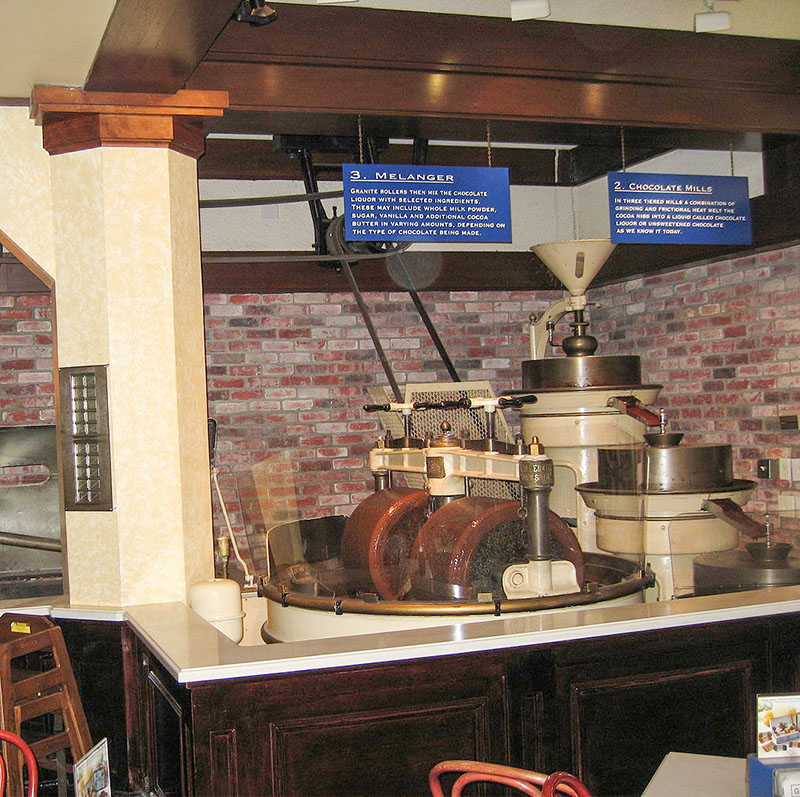
Step 5: Making Chocolate
At this stage, different ingredients are used in different proportions to make multiple types of chocolates. For example:
- To make milk chocolate, milk powder, cocoa butter, and sugar are added to the chocolate liquor. Without sugar, chocolate has quite a bitter taste.
- To make dark chocolate, sugar and cocoa butter are added to the chocolate liquor.
- To make white chocolate, milk powder, cocoa butter, and sugar are added, but no cocoa solids are included.
The proportions of these ingredients can be adjusted to create different flavors and textures of chocolate.
After that, the mixture is refined and conched, which helps create a smooth texture and uniform flavor.
Conching and Tempering Process
Conching is a process used to refine and smooth the texture of chocolate. It was invented by Swiss chocolatier Rodolphe Lindt. Conching involves mixing and agitating the chocolate at a high temperature for an extended period, typically several hours or more.
During this process, the chocolate is also tempered, which involves heating and cooling it to specific temperatures (usually between 88-90 degrees Fahrenheit for dark chocolate, 84-86 for milk chocolate, and 82-84 for white chocolate).
Tempered chocolate has a shiny appearance and a smooth snap when it is broken. The conching process helps remove any remaining impurities, create a uniform flavor and smooth texture, and develop the flavor and aroma of the chocolate.
Important Note: Some manufacturers add extra cocoa butter and other products, such as vanilla, to make their chocolate products extra creamy.

Step 6: Cooling and Packing
Once the chocolate is fully refined and conched, it is ready to be molded and cooled until it is ready to be wrapped and sold. Chocolate manufacturers may add additional ingredients, such as nuts or fruit, at this stage.
It is then molded into bars, coins, or other shapes and cooled until it is solid. Once the chocolate is cooled, it is ready to be wrapped and sold all over the world! This sweet treat is also consumed as hot chocolate.

In Conclusion: How is Chocolate Made
Making chocolate is a complex and artful process that involves various steps and techniques. From harvesting the cocoa beans and fermenting them to creating a smooth texture and uniform flavor, the process of making chocolate is time-consuming.
It requires a great deal of skill and attention to detail as well. However, the result is a delicious and beloved treat that is enjoyed by people all over the world.
Its flavor and texture can vary depending on the specific ingredients and techniques used in the production, making it a versatile and endlessly fascinating food.
Read Next:
